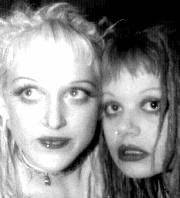
Right before their Salt Lake City concert on December 13, 1997, KRCL DJ's Alan Moss and Avant Bone (Alan Chow), along with me, sat down with Tina Root and Susan Wallace of Switchblade Symphony for a very impromptu interview.
Alan: So you have two full length albums out now and some other singles. Wasn't there an album that was just released for concert-goers on the last tour?
Susan Wallace: Yes, that was the Scrapbook CD that we put together. It was mostly based on our two demos that were self-released. A lot of people wanted to have them for their own collection. We weren't really planning on releasing them, we didn't think it was our best material, but it was in such high demand. That CD was not released by Cleopatra, just by us, for our fans.
Tina Root: That was something special, we only made 1500 of them. This time we have comic books. Those will be available in the stores eventually. But we wanted to have something different for the tour.
Susan Wallace: The person that did the artwork for the comic book is amazing. It was the guy that does the Crow comics. He had sent us some artwork just because he was a fan. We really liked what he did, then the idea of a comic book was tossed in the air. We met with him and talked to him for a couple of minutes. He took a couple of pictures of us, then he made the comic off it. So the phrasing isn't really things that we would say. Personality-wise it's based on a lot of the song material on Serpentine Gallery and what he picked up in the few minutes that he talked to us. It's like a scary child's tale kind of thing.
Alan: Do you have anything planned for the future, are you going to head back to the studio?
Susan Wallace: Well, I've been writing. Right after we finished our second tour, we got back on the 4th of July, I just locked myself in my room for two months. I usually do most of my writing in my room with my computer and all my toys. I just keep myself there, isolate myself from everything. I have all these old videotapes and photographs that I look at to try to get me into that frame of mind. So we have some songs ready. When we get back we're going to make a video for "Soldiers." Then probably we'll just take a break and work on some new material. We would like to get an opening slot for a bigger band, but we haven't really had any luck right now because we're sort of in the middle where we can't be classified as one thing. Some bands, what they hear of us is not really what we are. They feel we're too "gothy" or we're too one thing or the other, and they don't really know what we're about. They haven't seen us, so they don't know.
Avant Bone: Is that a problem with the music industry?
Tina Root: A lot of it has to do with our record label and its resources, and the way that we're promoted as a band. We really are not into the whole scene division thing that's going on right now. We like meshing different styles of music with our own. We feel we have a core sound, and we're able to experiment with different types of musicians. Like on this disc, Bread and Jam for Francis, we have a DJ scratching.
Avant Bone: That's a comment that somebody said to me the other day, that the new album was different from the previous albums, that they thought it was trip hop.
Susan Wallace: It does have trip hop elements in it, but people have to understand also that first of all, Serpentine Gallery is really old. If anyone goes back and looks at a picture of themselves, what they were doing, where they were working or what they were listening to years ago, it'll be different. There has to be some kind of growth, you have to keep evolving. In addition to that, half the songs on Serpentine Gallery were two years old when we put them on it. Those were songs that we had done before we were ever on Cleopatra, "Gutter Glitter," "Mine Eyes," "Bloody Knuckles," and "Bad Trash." We also had a really low budget, we didn't have a lot of capabilities that we had on this album. We didn't have the ability back then to get a really good producer or have a live drummer. We didn't have a lot of the resources, and we were also a lot younger. So we've improved and expanded in a lot of ways. We feel like whatever we do it's always going to have our elements. It's always going to have Tina's very melodic, operatic, or weird vocals. I'll always be doing the harpsichord, string stuff with a heavy groove under it. And maybe we'll want to have an upright bass player, or a trumpet player, or a male falsetto. We like to integrate other things in to have different feels, but we want to keep our same elements going on.
Alan: Do you see a further progression in the future to experiment more?
Tina Root: Yeah, we want to just keep feeding our minds, we don't want to become stagnant. We don't ever want to write in order to fit into any specific scene. There's so many different types of music to take from and to use to your benefit, whether you're listening to it or writing it. We don't want to limit ourselves.
Avant Bone: There are always those people who will resist change or something different.
Susan Wallace: Yeah, the "I'm too cool for that" kind of thing. But everybody does it, I'd be a total hypocrite if I said that I didn't. Everybody compares people or classifies people. Mostly when we put an album out, it's all about what's going on with us emotionally, what we've seen the last tour, everything that happened and the people that we met, everything that happens when we get home. The album is based on all of our own personal thoughts and feelings. Everything that we put out, regardless of how it sounds, it's going to be 100% of our soul in it.
Alan: Where did the name Switchblade Symphony come from?
Tina Root: I first started taking voice when I was in theater, and then I started taking lessons. I had a vocal teacher who wanted me to go classical. Then I found out who Nina Hagen was. I love how she meshed classical singing with punk rock. It's like taking a symphony or the different parts of a symphony, the intricacy of it and cutting it up with a blade, then putting in other parts and different types of music -- whether it's somebody scratching or me singing strange or whatever. You can take things and cut them up and put them back together again into something new and different.
Alan: How has Cleopatra Records been to work with, has that been a good arrangement?

Tina Root: It's been good for us. If we would have been signed onto a major label earlier on it might have been kind of frightening for all of us. So we've been able to retain creative control, which has been really nice. The only problem we have right now is with lack of promotion in different areas, different genres of music. We totally appreciate the gothic scene, but we feel we have an ability to venture out to different types of scenes, to affect people that aren't necessarily from the gothic scene. Like when we're on tour and we're playing clubs, the staff at the clubs end up coming up to us going "God, you know I have never heard of your band and I totally love you." It's because we've been promoted in Gothic type, Propaganda-type magazines and stuff. So that's our only problem really with them.
Susan Wallace: We are pigeonholed in that sense, but they are really good. They make suggestions to us here and there, they're really into doing tributes and covers, but they basically let us do whatever we want. We have full control over whatever we want to do, so that's really nice, it's a luxury that you don't think should be a luxury, it should be a right. But that's not how it works.
Alan: Do you like doing covers?
Susan and Tina: No
Susan Wallace: We did one cover, we did Siouxsie and the Banshees "Nightshift." We did it in like a day. They kept asking, we kept saying no. Then the day before it was going to go out we're like, okay we'll do it, so we put this thing out really fast. It was interesting, but I would rather focus on my own music and put the time, money and energy into my own creativity rather than doing somebody else's song. I've seen other people do it, and I think some people can do it when they put their own thing out. I'm not referring to anybody like Vanilla Ice or Puff Daddy who completely bastardize and take all the integrity out of a piece of art then they call it their own. I'm not about that at all. A lot of covers are really cool if they're done in the right way, like when Bananarama did the song "Venus." I just feel like right now I'd rather focus on what we're doing instead of what someone else is doing.
Alan: If you had your choice of bands to tour with, what would be a couple of acts that you think you would fit really well with?
Tina Root: We were up for the Sneaker Pimps tour and we missed it, I guess just by a hair. In fact, earlier I was talking to our booking agency and he said that we still had a chance to get on that tour, I think that would be really good for us. I'd like to tour with Bjork, Portishead...
Susan Wallace: or Marilyn Manson, or someone a little bit different. We're trying to find someone that is in between. I would love to play with Neurosis. I think that a lot of the people that like them would like us, and some of them wouldn't. Some of them would want something harder, darker, whatever. But I'd love to play with them, they really are intense. There's no chance in hell it'll ever happen, but I would love to play with Tom Waits. He tours once every ten years, I don't know if he'll ever go out again, but if he did I would just, I'd do anything.
Alicia: There's this piece in "The Event" about your show, it says that you make Trent Reznor sound like sunshine in comparison and that you're like a feminized Marilyn Manson.
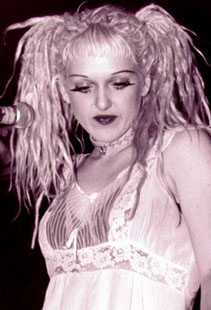
Tina Root: We've had comparisons a lot with Marilyn Manson, and I tend to believe it's more of a visual thing. When I see them in their videos, they're almost like cartoon characters, and we get really animé on stage. Plus there's this weird like strange childhood thing that both bands have in common. I look at them as being completely on the evil side, and I look at us as being on the good side. So we're complete opposites in a sense which is maybe why we get comparisons with them. Visually there's a lot of stuff going on that's somewhat similar I would say.
Susan Wallace: Lyrically, the content isn't like them, but it is mostly a visual shock value type thing. I think whoever is the video director for both those bands is amazing. We want to get to the point where we have that, we want the budget that we can make a cool video, that we can have cool theatrics. When we do home shows, we always have cool theater stuff, props and costumes and stuff that we can't do when we're touring. We don't have the capabilities right now. But we want that, we want to get bigger so we have a bigger budget so we can give our audience what we have. Right now we feel like we're only giving them a portion of what we have.
Alicia: What would you have in your live shows ideally?
Tina Root: Much more theatrics going on, a lot of props. We would make our own little land on stage. It'd be so fun, swings, stuff like that.
Susan Wallace: We'd like to create a different area, swings, men on stilts, juggling midgets, ballerina dancers. We'd like to have more of a different crew, like have a DJ scratch on one song, a bass player on one song, have different musicians to play with and more stage props. But we always do something different. We did a dark carnival theme where we all dressed up like clowns, and had a spinning thing with knives in it. We did a winter theme where the whole stage was blue. We had ice on the walls, we all wore these big white wigs, our faces were all silver. We did a forest theme with tons of trees all over the stage. We want to be able to do that when we travel. When we played with Type O Negative they had two snow machines, and for the climax of the show, the snow came off either side of the stage. It was huge, so pretty. We were like, "How much are those a week?" figuring out how long it's going to take us before we can get something like that.
Tina Root: We have a bubble machine and we have two cats that we brought with us on our last tour, these big tall cats they're like four feet tall and they're white.
Susan Wallace: and Tina made them.
Tina Root: and they're glittery and they're really pretty.
Susan Wallace: They were so cool. We didn't bring them this time though because we didn't want to overdo it. The bubbles can only go for so long.
Tina Root: We didn't want it to be cheese.
Alicia: There's one thing I wanted to ask you about your personal opinion, not according to Switchblade Symphony, but in your lives, what do you think that the term gothic means?
Tina Root: I personally feel that the gothic scene is somewhat afraid of showing a lot of human emotion. I feel like there's a lot of pressure on the younger kids in the gothic scene to remain very tactful and very closed. Like when we first started playing shows for the gothic scene in San Francisco, they were really afraid to really get into the show, to move and to feel a groove. We got them moving, and I feel like we kind of somewhat, not really, educated them...
Susan Wallace: We made a little bit of progress, we encourage people to move.
Tina Root: Yeah, we made progress. We want people to feel comfortable with being human. The whole fang thing is cool for people just as long as they don't feel that it's necessary to exist. You know, everybody's human and if you don't fit that specific visual gothic "look" you shouldn't be shunned from the scene. That scene kind of judges people on "the look," and I'm not really into that.
Susan Wallace: I feel also really strongly that every gothic scene in every town that we've been to is made up of a lot of very well-read, intelligent, creative people. One person is a photographer, one's a student, one's a musician, one's a writer. There is so much creativity and sensitivity in the scene. The thing that bothers me is that I feel like right now the public is really interested in this underground scene and what is being projected is this really lame image of this idiot who goes on Jerry Springer and is talking all this bullshit. It takes all the integrity out of the scene. People on the outside don't see it as a beautiful thing because they're seeing this person running around through a graveyard going, "Look at me, I love the graveyard, I love blood," and they're not seeing all the artisticness. I want people to see that, so they don't think that it is something it's not, because it's so much deeper than what the public sees. That's what bothers me about it, that certain people choose to project that lame image, and I don't think that's all there is. It's very much a cosmetic thing, and it's very much a visual thing, but there's so much more going on. I wish that people could see that.
Tina Root: Yeah, I think that that goes for every scene. Like the hip hop scene is associated with violence, but there's a lot of people filled with integrity in that scene. I think a lot of that has to be blamed on the press and on the music business. The music business has a lot of control over what people, the younger kids, are hearing on the radio. People that don't have the ability to go out and search for albums, people that live in smaller towns and only get MTV and major radio stations. So the business is really manipulating what is being heard by the youth. It kind of is depressing in a way what they're choosing to feed to them.
Susan Wallace: They're spoon-feeding them Hootie and the Blowfish and all this generic crap when there's so many bands with real integrity, if they would only feed them those lyrics that actually have something to say. Something that is not all about the artist and how many girls they have or how many guns they have. It's all about them, and it's so vain because you can use your popularity to teach somebody or to get a message across.
Tina Root: You have a responsibility, as soon as you get up there, we both feel you have a responsibility to at least project something that's intelligent and redeeming. There's so many bands out there that are being backed financially that really don't have the thing inside that really is necessary.
Susan Wallace: It's all marketing. Like the Spice Girls are all into this whole girlie thing and there's so much more they could say. Look at Tracy Chapman. She doesn't have to say shit and she's just beautiful, she's so cool.
Tina Root: That was a good move, by the music scene. I was really surprised by the business, that she got as much popularity or as much backing as the did. I was like, okay, there is hope. Somebody that has integrity just got signed and got a decent deal, and is on MTV.
Susan Wallace: It's because she's genuine. You can't argue with when someone's real, you can see it. Even if you don't like them. Like Jewel for example, I hate Jewel, but I think she's very real. I think she's sincere, and I have a lot of respect for her. But I wouldn't buy her album because I'm just not into her.
Alan: Does that mean you wouldn't mind getting on a major record label as long as you could maintain your integrity because it allows more of an avenue to expose people to your music?
Susan Wallace: Well it's a Catch-22. We've never been forced into that position where we fully understand the terms of it. If they say, "We'll give you this million dollar contract," or whatever they're going to do, what are the consequences of that? We don't know yet. We want to, we want to be on MTV, we want to be on major radio, but I can't get up in the morning and look at myself if I'm doing something that I hate. If what we're doing turns out to be mainstream, and I hope that we can...
Avant Bone: What a dirty word you just said.
Susan Wallace: But mainstream shouldn't be a dirty word.
Tina Root: It's not a dirty word. As long as you don't sell out to get there.
Susan Wallace: To me selling out is doing something that I don't want to do so that I get money. If I'm doing what I want to do and I'm a millionaire, I am totally successful. We're just squeaking by, but we're able to travel all around the world and make our music and play it for people. I feel so successful right now and happy, but I would be a lot happier if I had a little bit more money so that I could buy things like cat food and wine, whatever I want.
Tina Root: Our goal is to expose our music to as many people as possible, regardless of what kind of people they are. We would love to see a big huge melting pot of people in our audience, all different types of people identifying with our music. Because we're not trying to fit any specific type of person, we're just giving ourselves. Like she said earlier, if we become famous doing that then we've succeeded in getting our dream.
Susan Wallace: But we are a little bit afraid of losing the people that we have right now, because we do understand there is that "I used to like them but now I'm tired of hearing about them" or "Now they're different" or however they feel...
Avant Bone: Some might feel betrayed in some ways?
Susan Wallace: Yeah, I'm really afraid that we're going to lose some of those people. I know that we will and that we probably already have a little bit. I hope that they just know that we're still real, and I hope they'll just give us a chance, listen. I think the new album will take some people a minute to get used to because it maybe isn't what they're expecting, but it's totally us and it's real. We don't want to lose our fans that we have right now because they are so wonderful. The gothic scene generally has opened its arms to us and been so loving. Tina and I pay for everything ourselves. We can do that because people come to our shows, buy T-shirts and the album. That's the only reason that we're here and we don't want to lose them, we don't want them to feel that we turned our backs on them, ever.
Avant Bone: How did you two meet?
Tina Root: We met as musicians. She actually knew my brother before I knew her. Mutual friends introduced us, both of us were looking for people to work with. So we initially met on the phone and spoke for eight hours straight just going "Oh my God, oh my God, oh my God" either we were the same or we were the opposite so we balanced each other out. Since then we've been the same way, and luckily we've had this growth pattern that's been parallel. If we grow away from each other, we both learn about what the other person is learning about at that point. That's kind of what we want the gothic scene to do with us too is grow with us and not close its doors. Like if we bring a DJ up on the stage, to be open to that and to realize that there's other music beyond the scene that really is incredible they really need to listen to.
Avant Bone: It's a difficult thing fighting people's preconceived notions of what you should be.
Tina Root: Yeah but music is one thing that we all have as a society that everyone can understand. Why segregate that? Why segregate art when it's the one thing we have that we don't need to? There's so much segregation, so many different dress codes right now with the swing scene and all of this stuff. All of them have their redeeming qualities. If people were just to experiment with them, see what it's about.
Susan Wallace: Go experience it, see what it's about instead of just saying, "That sucks." At least check it out and say "I didn't like it." You can't say you don't like something if you don't know what it is.